Canada’s New Flying Laboratory and What It Means for Defence Innovation

TerraSense CEO Jozsef Hamari joined partners and government officials in Ottawa for the National Research Council’s launch of its new NRC research aircraft, designed to support testing and development across Canada’s defence innovation ecosystem.
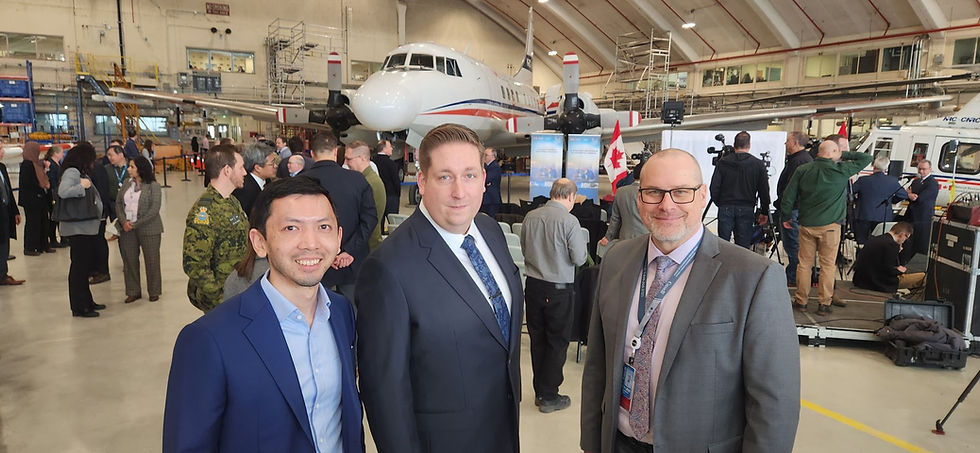
Inside the NRC Hangar
On March 9, the National Research Council hosted a defence innovation announcement inside its Flight Research Laboratory hangar in Ottawa.
The event brought together Minister of Industry Mélanie Joly, Minister of National Defence David McGuinty, Secretary of State for Defence Procurement Stephen Fuhr, and leaders from Canada’s aerospace and defence sector.
The announcement included more than $900 million in funding to the NRC as part of Canada’s Defence Industrial Strategy, aimed at strengthening domestic defence research, innovation, and industrial capacity.
Following the ministerial remarks and unveiling of a new Bombardier Global 6500 research aircraft, several technical demonstrations were presented inside the hangar.

One of those presentations focused on the role airborne research platforms play in supporting Canadian small and medium-sized defence technology companies.
A Platform for Testing Canadian Technology
TerraSense CEO Jozsef Hamari spoke about how research aircraft operated by the NRC have supported the development of Canadian sensing technologies.
“When you look at the aircraft, it’s easy to focus on the hardware. But the real value is the platform it creates for collaboration. Research aircraft allow companies like TerraSense to test sensing systems, collect real airborne data, and work directly with partners across academia, government, and the Canadian Armed Forces. The new NRC platform will help accelerate the development of Canadian defence technologies.”
For several years, TerraSense has used NRC aircraft to test sensor systems, collect operational data, and refine AI models in real flight conditions.
Airborne testing is an important step in the development of defence technology. Systems that perform well in simulation often behave differently once they are exposed to real terrain, environmental variability, and sensor constraints.
Research aircraft allow engineers to close that gap. They provide a platform where new technologies can be tested, refined, and validated before they are integrated into operational systems.
The new Bombardier Global 6500 expands that capability by offering a larger airborne research platform designed to support collaboration between government laboratories, industry partners, and defence organizations.
From Kelowna to the NRC Flight Lab
TerraSense develops airborne sensing technologies from its headquarters in Kelowna, British Columbia.
In collaboration with UBC Okanagan and industry partners, the company operates its own Airborne Sensing Laboratory using a modified Cessna aircraft equipped with advanced sensors. Known internally as Project Ogopogo, the platform supports data collection and AI model development across land, air, and maritime environments.
Project 'Ogopogo' or the Airborne Sensing Lab's plane in Kelowna, BC
This smaller research platform allows the team to experiment quickly and collect specialized datasets used to train and refine TerraSense systems such as MIST (Multimodal Input Surveillance & Tracking).
The NRC’s research aircraft extends this approach by providing access to larger platforms and shared testing infrastructure across Canada’s defence innovation ecosystem.
Why Shared Platforms Matter
Defence technology development rarely happens in isolation.
Universities, government research centres, startups, and the Canadian Armed Forces each contribute different pieces of the capability pipeline. Shared testing platforms allow these groups to experiment together and accelerate the pace of innovation.
Initiatives such as the NRC research aircraft and the new Drone Innovation Hub are designed to support this collaborative model.
By providing infrastructure where Canadian companies can test and validate emerging technologies, they help move research out of the lab and closer to operational use.
Looking Ahead
Canada’s Defence Industrial Strategy emphasizes strengthening domestic capability and supporting the companies building next-generation defence technologies.
“Access to airborne research infrastructure allows Canadian companies to move technologies from concept to operational testing much faster,” said Hamari. “Platforms like this help strengthen the entire defence innovation ecosystem.”
For TerraSense, collaboration with organizations such as the National Research Council plays an important role in translating research into operational capability.
Platforms that enable real-world testing help ensure that Canadian innovations move beyond prototypes and into systems that can support national security and allied operations.


Comments